
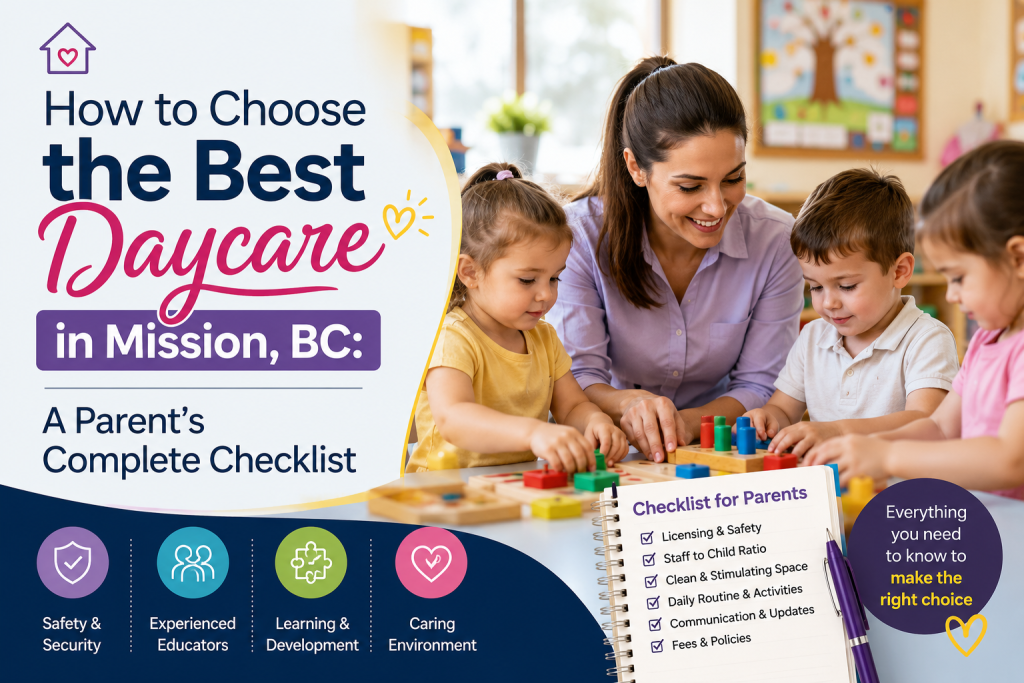
Choosing a daycare is one of the biggest decisions you will make during your child’s early years. You are not simply looking for someone to watch your child while you work. You are choosing the people, environment and daily routine that may shape a large part of your child’s development.
That is why searching for the best daycare in Mission, BC can feel overwhelming.
A centre may look attractive online but feel completely different during a visit. Another may have a long list of activities but provide little individual attention. Cost, location and operating hours matter, but they should not be the only reasons behind your decision.
The right daycare should make your child feel safe, welcomed and understood. It should also give you confidence that your child is receiving reliable care in an environment that supports learning, play and healthy development.
This parent-friendly checklist will help you compare daycare centres in Mission and make a more informed decision for your family.

1. Start With Your Family’s Practical Needs
Before contacting daycare centres, write down what your family genuinely needs.
Consider your working hours, commute, preferred start date and the number of days you need care. Some families require full-time care five days a week, while others may need a part-time schedule.
Ask yourself:
- What time do I need to drop off and pick up my child?
- Do I need care throughout the year?
- How far can I reasonably travel each day?
- Does my child need infant, toddler or preschool-age care?
- Do I need flexibility when my working schedule changes?
- What is my monthly childcare budget?
A daycare can offer an excellent program, but it may not be the right choice if its schedule does not work with your daily routine.
Location is particularly important. A centre near your home, workplace or regular commuting route can make mornings less stressful. Parents looking for daycare in Mission, BC should also consider traffic, parking and how easy the centre is to reach during busy drop-off and pick-up periods.
2. Understand the Type of Childcare Being Offered
Not every childcare arrangement in British Columbia operates in the same way.
The province recognizes licensed childcare, registered licence-not-required care, licence-not-required care and care provided in the child’s own home. Each option has different rules, limits and levels of oversight.
When comparing daycare centres, ask exactly what type of program is being offered.
A centre may provide:
- Group care for children under 36 months
- Infant and toddler care
- Group care from 30 months to school age
- Preschool programming
- School-age care
- Multi-age childcare
The correct program will depend on your child’s age and developmental stage. Do not assume that every daycare accepts infants or that every preschool offers full-day care.
Ask the centre to explain its program clearly, including the ages accepted, daily operating hours and whether children move into another classroom as they grow.
3. Confirm Licensing and Review Inspection Information
Licensing should be one of the first subjects you discuss with a childcare provider.
British Columbia’s Child Care Licensing Regulation sets requirements related to health and safety, staffing qualifications, staff-to-child ratios, supervision and the physical environment.
Parents can use Fraser Health’s childcare resources to search for licensed facilities in their community. Fraser Health also provides information about inspections, complaints and investigations.
When speaking with a daycare, ask:
- Is the facility licensed?
- What type of childcare licence does it hold?
- Can parents review the licence and recent inspection information?
- Have there been any outstanding licensing concerns?
- What procedures are followed if an incident occurs?
A professional daycare should be comfortable answering these questions. You should never feel that asking about licensing or safety is rude. It is a normal and responsible part of choosing care for your child.
4. Visit the Daycare in Person
Photographs and website descriptions can help you create a shortlist, but they cannot replace an in-person visit.
Try to tour the centre while children are present. This allows you to observe the normal atmosphere rather than seeing only an empty, perfectly arranged classroom.
Pay attention to how the environment feels when you enter.
Does it feel calm and welcoming? Are the children actively involved in play? Do educators speak to children respectfully? Are staff members down at the children’s level when talking to them?
Look beyond colourful walls and new toys. A good daycare does not need to look like an expensive showroom. It should feel clean, organized, safe and suitable for young children.
Check whether:
- Entrances and exits are secure
- Rooms have enough space for movement and play
- Toys and materials appear clean and age appropriate
- Washrooms and diaper-changing areas are well maintained
- Children have access to outdoor play
- Sleeping areas are safe and supervised
- Emergency information is easy to find
- Cleaning products and dangerous items are stored securely
Trust your first impression, but support it with careful questions and observations.
5. Observe How Educators Interact With Children
The quality of the relationship between children and educators matters more than expensive equipment or a long activity list.
Young children need caregivers who are patient, warm and emotionally available. They should feel comfortable asking for help, expressing feelings and exploring their environment.
During your visit, notice how educators respond when a child cries, becomes frustrated or struggles to join an activity.
Do staff members remain calm? Do they comfort the child? Do they explain what is happening rather than simply giving commands?
Ask the centre about staff qualifications, training and experience. You can also ask how long current educators have worked at the daycare. Frequent staff changes can make it harder for young children to form secure, consistent relationships.
Useful questions include:
- What qualifications do educators hold?
- Are staff members trained in first aid?
- How are new employees screened?
- How does the centre support ongoing staff development?
- Who will be my child’s main educator?
- How are substitute staff members selected?
A confident, experienced team should be able to describe not only what they do, but why they do it.
6. Ask About Staff-to-Child Ratios and Supervision
Young children need close attention, especially during meals, outdoor play, transitions and toileting.
British Columbia’s childcare regulations include staffing and group-size requirements for licensed programs. However, parents should still ask how supervision works throughout an ordinary day.
A centre may technically meet its required ratio but organize the day in a way that leaves educators rushed. Ask what happens during staff breaks, absences and busy arrival times.
Find out:
- How many children are in each room?
- How many educators are normally present?
- Does the ratio change during opening or closing hours?
- Who supervises children when an educator takes a break?
- How are children counted during indoor and outdoor transitions?
You want to know that your child will be seen, heard and properly supervised rather than simply being one child in a crowded room.
7. Review the Daily Routine and Learning Approach
Children learn through ordinary experiences: talking, playing, building, singing, moving, observing and asking questions.
A strong daycare routine should provide a healthy balance of:
- Child-led play
- Educator-guided activities
- Indoor and outdoor time
- Quiet and active periods
- Individual and group experiences
- Meals and snacks
- Rest or nap time
- Creative and sensory activities
Kidz Hub Early Learning describes its approach as encouraging curiosity, creativity, critical thinking and independent thought. Its programs are designed to nurture children’s individual potential through an engaging early learning environment.
When touring any daycare in Mission, ask educators how they plan activities and adapt them for different children. A rigid routine that expects every child to perform in the same way may not suit young learners.
The program should be structured enough to help children feel secure but flexible enough to respect their interests, abilities and individual pace.
8. Discuss Meals, Allergies and Health Policies
Food is an important part of a child’s daycare experience.
Ask whether meals and snacks are provided or must be packed from home. Request a sample menu when food is included.
Check whether the menu offers variety and is suitable for your child’s age. You should also understand how the centre manages allergies, food restrictions and cultural or family preferences.
Ask about:
- Handwashing routines
- Diaper-changing procedures
- Toilet-learning support
- Medication administration
- Illness and exclusion policies
- Allergy emergency plans
- Cleaning and sanitizing practices
You should know when a sick child must remain at home and how the daycare informs families about possible exposure to illness.
Clear health policies protect children, staff members and families. They also prevent misunderstandings when your child becomes unwell.
9. Learn How the Centre Communicates With Parents
You should not have to guess how your child spent the day.
Good communication may include short conversations at pick-up, written daily reports, photographs, digital updates, newsletters or scheduled parent meetings.
For infants and toddlers, parents may need updates about:
- Meals and bottles
- Diaper changes
- Naps
- Mood and behaviour
- Activities
- New skills or milestones
Ask how the centre handles more serious concerns. You should know who to contact if your child is struggling, if you notice a change in behaviour or if you disagree with a decision.
Communication should work both ways. Educators should share meaningful information while also listening carefully to what parents say about their children.
10. Understand Fees, Deposits and Financial Support
Always request a complete fee breakdown before enrolling.
In addition to monthly tuition, ask about registration fees, deposits, late pick-up charges, meals, supplies, field trips and fees for days when the centre is closed.
Clarify whether you continue paying when your child is sick or away on holiday. You should also ask how much notice is required if you decide to leave the program.
Eligible families in British Columbia may receive help with childcare expenses through the Affordable Child Care Benefit. The amount can depend on factors such as household income, family size and type of childcare. The province provides an online estimator, although an estimate does not guarantee approval or a specific payment.
Ask the daycare whether it assists families with the necessary childcare arrangement forms.
11. Ask How the Centre Handles Difficult Moments
Every child has challenging days.
Toddlers may bite, push, refuse to share or become overwhelmed. Preschoolers may argue, ignore instructions or struggle with transitions.
Ask how educators respond to these situations.
A high-quality centre should focus on guidance rather than shame or harsh punishment. Educators should help children name their feelings, understand boundaries and learn safer ways to communicate.
Ask specifically:
- How do you handle biting or hitting?
- What happens when a child refuses to participate?
- How do you support separation anxiety?
- How are parents informed about repeated behaviour?
- What guidance methods are never used?
The answers will tell you a great deal about the centre’s values.
12. Review Policies Before Signing Anything
Do not enrol based only on a verbal conversation.
Read the parent handbook, enrolment agreement and centre policies carefully. These documents should explain fees, absences, holidays, illness, emergencies, behaviour guidance, medication, photography, late collection and withdrawal procedures.
Ask for clarification when something is unclear.
A reliable daycare should be transparent about its expectations. Policies protect the centre, but they should also help parents understand what they can expect in return.
Your Final Daycare Checklist
Before choosing a daycare in Mission, BC, make sure you can confidently answer yes to the following questions:
- Does the location and schedule work for our family?
- Is the program suitable for my child’s age?
- Have I confirmed the facility’s licensing information?
- Does the centre appear clean, secure and well organized?
- Are educators warm and respectful toward children?
- Are staffing levels and supervision procedures clear?
- Does the daily routine include meaningful play and learning?
- Are health, allergy and emergency policies documented?
- Will I receive regular updates about my child?
- Do I fully understand the fees and enrolment conditions?
- Does my child appear comfortable in the environment?
- Do I feel respected when I ask questions?
Take Your Time and Trust What You Observe
The best daycare in Mission, BC will not necessarily be the closest, newest or most expensive centre. It will be the place where practical needs, professional standards and your child’s emotional needs come together.
Visit more than one centre when possible. Ask detailed questions, review the policies and pay attention to how educators interact with children.
Most importantly, notice how you feel after the tour. You should leave with a clear understanding of the program and a sense that your child will be treated with patience, warmth and respect.
Kidz Hub Early Learning in Mission provides early learning programs built around curiosity, independent thinking and the development of each child’s unique potential. Families searching for infant, toddler or group childcare can contact the centre to learn about program availability, arrange a visit and decide whether its approach is the right match for their child.