
Choosing between daycare and preschool can be confusing, especially when many childcare centres use the terms in slightly different ways.
One program may call itself a daycare but still offer structured early learning activities. Another may use the word preschool even though children attend for several hours each day. From a parent’s point of view, both options may appear very similar.
The biggest differences usually involve the child’s age, operating hours, daily routine and the main reason families use the program.
Daycare is generally designed to provide dependable childcare while supporting a child’s development throughout the day. Preschool usually offers a shorter early learning program intended to help children build social, communication and school-readiness skills before kindergarten.
Neither option is automatically better. The right choice depends on your child’s age, personality, daily routine and your family’s need for care.
This guide explains the difference between daycare and preschool so you can decide which environment is the better fit for your child.
Daycare vs Preschool: The Quick Answer
The simplest way to understand the difference is this:
Daycare usually provides longer hours and may care for children from infancy through the preschool years. Preschool generally serves children from about 30 months to school age and operates for fewer hours each day.
In British Columbia, licensed preschool programs are intended for children from 30 months to school age. Most operate during the school year and run for approximately one to four hours per day. Under BC’s Child Care Licensing Regulation, a licensed preschool program cannot provide more than four hours of care per child each day.
Licensed group childcare programs are separate categories. They may provide care for children under 36 months or for children from 30 months to school age, depending on the centre’s licence and available programs.
Here is a general comparison:
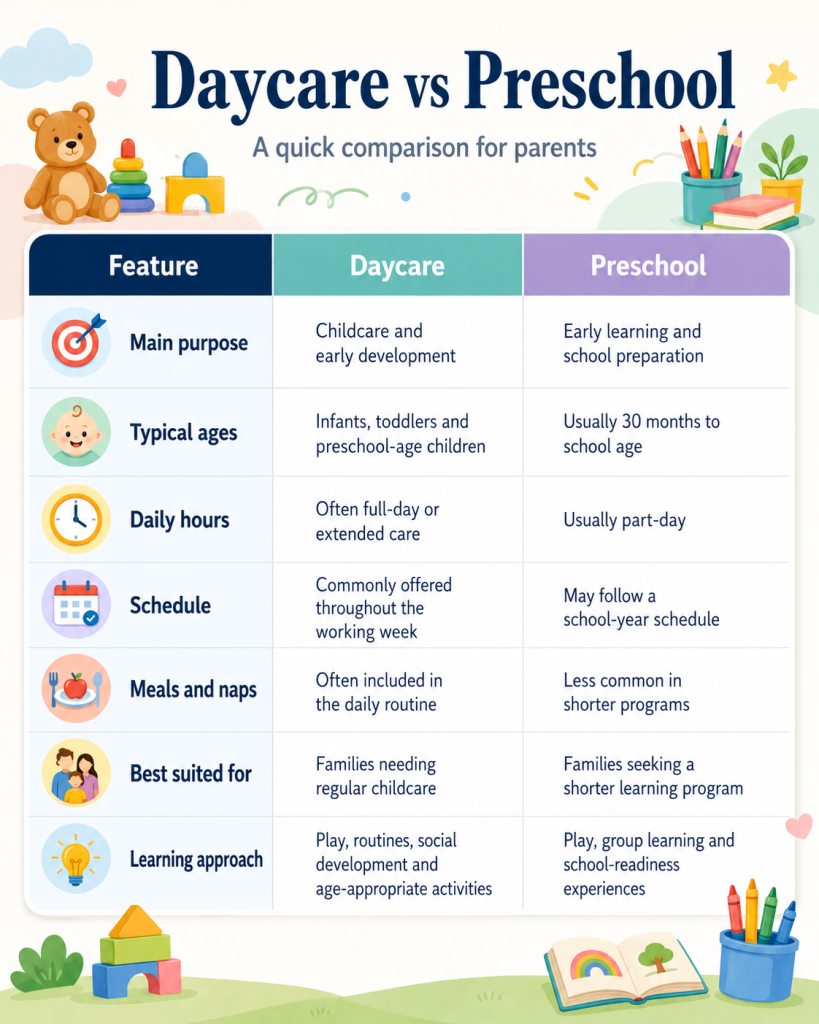
These are general differences. Individual centres may structure their programs differently, so parents should always confirm the schedule, age group and licence type directly with the provider.
What Is Daycare?
Daycare is a broad term commonly used for childcare provided while parents or caregivers are working, studying or managing other responsibilities.
A daycare centre may accept babies, toddlers and children who have not yet started school. Some facilities also provide before-school and after-school care for older children.
A typical daycare day may include:
- Free play
- Group activities
- Stories and music
- Outdoor play
- Meals and snacks
- Nap or quiet time
- Creative activities
- Language development
- Physical movement
- Social and emotional learning
Good daycare is not simply supervision.
Children learn through everyday routines, conversations, relationships and play. They practise taking turns, expressing their needs, following simple instructions, solving problems and becoming more independent.
Licensed childcare programs in British Columbia must meet provincial requirements involving health and safety, staff qualifications, supervision, group sizes, equipment and programming. Licensed facilities must also give children opportunities for social, emotional, physical and intellectual growth through developmentally appropriate activities.
What Is Preschool?
Preschool is an early learning program for children who have not yet entered kindergarten.
It usually focuses on helping children become comfortable in a group environment while building the skills they will need for school. Preschool does not need to feel like a traditional classroom. Young children learn best through play, movement, conversation, discovery and hands-on activities.
A preschool program may include:
- Storytelling and picture books
- Songs, rhymes and music
- Art and sensory play
- Early counting and number awareness
- Colours, shapes and patterns
- Fine-motor activities
- Group conversations
- Outdoor play
- Following routines
- Taking turns and cooperating with others
In British Columbia, preschool usually serves children from 30 months to school age. Programs commonly operate for one to four hours a day and may follow a September-to-June school calendar.
Because preschool hours are generally shorter, it may not provide enough coverage for parents who need full-day childcare.
The Main Differences Between Daycare and Preschool
1. Age of Enrolment
Daycare may accept children from infancy, depending on the program’s licence and available spaces.
Preschool is generally intended for children who are at least 30 months old and have not yet started school in British Columbia.
For families with babies or younger toddlers, daycare is usually the relevant option. Families with a three- or four-year-old may be able to choose between group daycare and preschool.
2. Length of the Day
Hours are often the most important practical difference.
Daycare commonly provides care for a substantial part of the working day. Children may arrive in the morning and remain until the afternoon or early evening.
Preschool is usually shorter. A child may attend for a morning or afternoon session several days per week.
A preschool schedule can work well when a parent is at home, works flexible hours or has another childcare arrangement. Families needing consistent full-day coverage will normally find daycare more practical.
3. Daily Routine
A full daycare day must meet a child’s needs across several hours. It may include meals, snacks, toileting or diaper changes, rest periods, outdoor time and multiple transitions.
Preschool has less time available, so the routine is usually more concentrated. Children may move through welcome time, free play, a group activity, a snack and outdoor play within one session.
Both environments should provide a balance of active play, quiet experiences, conversation and social interaction.
4. Educational Focus
Parents sometimes assume that daycare provides care while preschool provides education. In practice, the difference is not always that simple.
A high-quality daycare can have a thoughtful early learning curriculum. Educators may plan activities supporting language, early mathematics, creativity, physical development and social skills.
Kidz Hub Early Learning in Mission describes its approach as learning through play, with a balance between child-directed and teacher-directed activities, individual and group experiences, and indoor and outdoor learning. The centre also highlights cognitive, social, emotional and physical development within its curriculum.
Preschool may place more visible emphasis on kindergarten readiness, but this should not mean worksheets and formal lessons throughout the session. At this age, school readiness includes being able to communicate, participate in a routine, manage emotions, ask for help and interact with other children.

5. Meals, Snacks and Naps
Full-day daycare programs often need to accommodate meals, snacks and rest periods.
Younger children may still require regular naps. Daycare classrooms are generally organized to support these needs as part of the daily routine.
A short preschool session may include a snack but not lunch or nap time. This can be suitable for older children who are comfortable with a shorter schedule.
Parents should ask what food is provided, how allergies are handled and whether the program can accommodate their child’s normal sleep routine.
6. Family Schedule
Daycare is often chosen because a family needs reliable care during working hours.
Preschool may be chosen mainly to give a child experience outside the home, even when regular childcare is not required.
Think honestly about what your family needs. A wonderful two-hour preschool program may still create stress when you need eight hours of care. Similarly, a child may not need a full daycare schedule when your primary goal is a few mornings of group learning and social interaction.
Is Daycare Educational?
Yes, daycare can be highly educational when the program is developmentally appropriate and led by caring, qualified educators.
Young children do not separate care from learning. A toddler learns language while speaking with an educator at lunch. A preschooler learns problem-solving while building a tower. Children practise emotional regulation when they wait for a turn or recover after becoming frustrated.
The strongest childcare programs create learning opportunities naturally throughout the day.
Look for a daycare that provides:
- Open-ended play materials
- Books and storytelling
- Music and movement
- Outdoor exploration
- Creative activities
- Warm conversations
- Predictable routines
- Opportunities to make choices
- Support for independence
The goal should not be to push children into formal academics too early. It should be to build curiosity, confidence and a positive relationship with learning.
Does My Child Need Preschool Before Kindergarten?
Preschool can be beneficial, but children do not all need to follow the same path before kindergarten.
A quality daycare can also help children develop many of the same school-readiness skills. These include listening, communicating, joining group activities, separating from a parent, following routines and caring for personal belongings.
The program’s quality and suitability matter more than the label on the door.
A child who attends a nurturing, play-based daycare may be just as prepared for kindergarten as a child attending a program called preschool.
Parents should focus on what children actually experience each day rather than choosing a program based only on its name.
Daycare May Be Right for Your Child When:
Daycare may be the better option when:
- You need full-day childcare
- Your child is younger than preschool age
- You need care five days per week
- Your child still needs a daily nap
- You prefer one consistent setting for care and learning
- Your child benefits from a predictable full-day routine
- You need care throughout more of the calendar year
Continuity can be a major advantage. Children may remain within the same centre as they move from an infant or toddler room into a program for older children.
Preschool May Be Right for Your Child When:
Preschool may be a good fit when:
- Your child is at least 30 months old
- You need only part-day programming
- Your main goal is group learning and social experience
- Another caregiver is available for the rest of the day
- Your child is ready for a shorter, structured routine
- You want a gradual introduction to learning outside the home
- A school-year schedule works for your family
A shorter session can be a gentle starting point for a child who has not previously spent much time away from a parent.
What Should Parents Look for in Either Program?
Whether you choose daycare or preschool, visit the centre before making a decision.
Observe how educators speak to children. They should be warm, patient and respectful. Notice whether children appear engaged and comfortable rather than overly controlled or left without meaningful interaction.
Ask about:
- Licensing
- Educator qualifications
- Staff-to-child ratios
- Group sizes
- Daily activities
- Outdoor play
- Behaviour guidance
- Illness policies
- Allergies and medication
- Parent communication
- Fees and closure dates
- Drop-off and pick-up procedures
Families in Mission can use Fraser Health’s childcare resources to search for licensed facilities and review local childcare information. Mission is included within Fraser Health’s eastern region listings.
Which Is Right for Your Child?
There is no single answer that works for every family.
Choose daycare when you need dependable, longer-hour care combined with age-appropriate learning and development. Choose preschool when your child is old enough for the program and your family wants a shorter early learning experience.
Before enrolling, look beyond the name of the program. Ask what an ordinary day looks like, how educators comfort children, how much outdoor time is provided and how the centre communicates with families.
The best environment is one where your child feels safe, valued and excited to participate.
Kidz Hub Early Learning in Mission, BC, provides a play-based environment designed to support children’s cognitive, physical, social and emotional development. Families can contact the centre to discuss their child’s age, care needs and program availability before deciding which option is the best match.
Frequently Asked Questions
Is daycare the same as preschool?
No. Daycare usually provides longer childcare hours and may accept children from infancy. Preschool generally provides a shorter early learning program for children from 30 months to school age in BC.
However, daycare and preschool can both include play-based learning, social development and school-readiness activities.
Is preschool better than daycare for learning?
Not necessarily.
A high-quality daycare may offer an excellent early learning program. The educators, environment, relationships and daily experiences are more important than the program’s name.
Can a three-year-old attend daycare instead of preschool?
Yes. Many three-year-olds attend licensed group childcare programs rather than separate preschool sessions. The right option depends on the family’s schedule and the child’s individual needs.
Which option is better for working parents?
Full-day daycare is usually more practical for parents who work regular hours. Preschool sessions may require additional childcare before or after the program.
What age should a child start preschool?
In British Columbia, licensed preschool programs generally accept children from 30 months to school age. Individual programs may set their own enrolment requirements within licensing rules.